Thursday, March 17, 2016

In honor of St. Patricks Day - Our Irish Heritage


Every year on this day I am forced to remind my children that they are indeed Irish although they don't look it.  And here is the proof....


My Great Grandmother, Winifred Cooney Cox (1868-1956)


In the year of 1891, 23 year old, Winnie left her Irish homeland and family to come to America. She met her future husband, an Englishman, aboard the ship that brought the couple across the Atlantic.  Winnie & John Cox settled in New Rochelle NY where they raised two daughters, Margaret (Flo) Cox Hennessy and Mary (Mae) Cox Schoenherr.

Winnie was born in Galway, one of the eight children of Mary Ryan and Thomas Cooney.   Thomas & Mary were wed in Limerick, Ireland on May 26, 1867.  Census records show the family living in East Clare and then Killuran in 1900 and 1910 with Thomas, a widower by then, working as a farmer.  My 2nd great grandmother, Mary Ryan Cooney, was baptized on July 11,1841 in Ballinakill, Galway Co., Ireland the daughter of  John and Mary (Salman) Ryan.

My Great Grandfather, Patrick J. Hennessy (1874- )

On January 11, 1894, 19 year old Patrick emigrated to America from his home in Conahy, Killkenny Ireland.  Patrick was born in Kilkenny, the son of Patrick Hennessy (b.1839) and Catherine (Brennan) Hennessy (b.1845).

Patrick (b.1874) married Mary J. Archer in approximately 1895.  They settled initially in Brooklyn NY moving to New Rochelle in 1901 where they raised their four sons until Mary passed away from Meningitis in 1905.

My Great Grandmother,  Mary Archer Hennessy (1867-1905)

Mary Archer is believed to have been born in 1867 the daughter of Richard Archer & Sarah (Andrew) Galloway Archer.  The family may have been from Ballymena in Northern Ireland and emigrated to the United States in the 1875.

Tuesday, April 14, 2015

Fordham University - perhaps the last stop in our arduous, amazing, agonizing college search.

I'm sorry it's been so long since I last posted.  I have been embroiled in motherly duties, helping my daughter wade through oodles of College brochures, facts, figures and websites to find the place she will call home for the next four years.  As a parent, I am supposed to guide her objectively, steer but not interfere, keep my emotional ambivalence with this stage in her life under wraps and insure we can actually foot the bill.  Our oldest is a sophomore in college now and with two more future college students in the wings, that affordability issue is a big one. 
Keating Hall
Fordham University

We've spent the last few weeks trekking from one admitted students day to the next and I'm a little surprised, but happy that Fordham University has made the short list.  We're down to 2 or 3 schools at this point.  I can't say how this will turn out come May 1st, but as you know, our family does have a history at this very old and prestigious institution.


My grandfather, Thomas F. Hennessy (1899-1954) graduated from Fordham University in 1922 after serving on the Students Army Training Corp at Fordham in 1918. 


Thomas won his own scholarship for $100 towards 
tuition and $100 for maintenance in 1921.  He graduated from Fordham Law School in 1925 and served as a member of the Fordham Law School faculty. He is memorialized in 1954 in "The Advocate," a publication of the Alumni Assoc. of Fordham Law School.  After graduating, Thomas went on to serve as a vice chairman of the Westchester County Democratic committee.

Our first visit to Fordham last summer did not go so well.  My daughter, who teeters between being agnostic and atheist, was immediately turned off by this decidedly religious institution as well as a perceived lack of diversity.  She was also intimidated by the stately, looming buildings in spite of their architectural beauty.  Our family heritage was inconsequential to her. No, this was not her kind of school!  

As she continued her search, Fordham's academic offerings and reputation as well as it's proximity to Manhattan drew her back in.  Thus, when they offered her a scholarship, it seemed worthy of another look.  Sure enough, a year later and a whole lot wiser, she found the beauty and history of Fordham inviting and engaging.  I thought all might be lost on my-so-not-into-sports kid when the President devoted much of his speech to Fordham's affiliation with the Yankees, taunting Mets and Red Sox fans.  Yet, when the Father began to talk about Fordham's mission to create graduates who are "bothered" by injustice and the tough questions and issues of our time, it resonated loudly, like the crack of the bat hitting a walk off home run.


1935 Fordham University
 Founded as St. John's College in 1841
The name was changed
to Fordham in 1907
The Law school and
Medical Schools opened in 1905


As for the Catholic tradition of Fordham, she's standing firm on her agnostic-atheist fence.  It could be interesting for her to debate spirituality at Fordham with those infinitely more versed in the subject than I.   Of course I understand her position, having gone through my own period of exploration and I would expect nothing less from her.  She hates it when I tell her that though, feeling it invalidates her position, as if it's just a phase.  And she's right.  This is her journey and whose to say what discoveries she'll make and where she will end up.  But, for the next four years, I wouldn't mind her being in the Bronx, less than an hour away! 


Monday, January 19, 2015

Grandma Winnie's Ancestry - Winifred (Cooney) Cox (1868-1956)

WINIFRED J. COONEY COX (1868-1956) 

Kilkishen Castle, Co. Clare
Winifred Josephine Cooney (my great grandmother) was born on April 11, 1868 in Galway, Ireland and was baptized in Kilkishen, Clare, Ireland.  Winifred was the first child born to Thomas Cooney (1847- ) and Mary Ryan Cooney (1841-abt. 1895).  
She had 4 sisters and three brothers:  Anne  (1869), John (1870), Bridget (1871), Pat (1873), Daniel (1877), Mary (1879), Margaret, 'Maggie' (1882), and Thomas (1886).  Most of her siblings were born in Kilkishen or Ballinabrone, Co. Clare which is where the family lived while Thomas worked as a farmer.  


    Winifred Cooney's marriage record 
    provides the names of her parents as 
    Thomas & Mary Ryan
  • Winifred emigrated to America about 1891,according to family, on the same ship as her future husband, John Cox. She was just 23 years old at the time.  John and Winnie married in 1899 in Massachusetts, settling first in Manhattan, then moving to New Rochelle, NY.  
  • Winifred's sister, Maggie Cooney followed her to America in 1899 and lived with John & Winnie until her marriage to Michael Sullivan after 1905. 

  • To learn more about Winifred's life in America see prior blog entry:  http://hennessycox.blogspot.com/2014/03/john-cox-ii-and-winifred-j-cooney-cox.html


Thomas & Mary Cooney 

Thomas Cooney & Mary Ryan wed in Limerick Ireland on May 26, 1867.  The city of Limerick is on the southern border of Clare Co. and Limberick Co. According to Census records, Thomas was a widower by 1900.  Records show the family living in East Clare and then Killuran in 1900 and 1910.  

Thomas was born in 1847, the son of Patrick Cooney possibly in Scariff, Clare Co.  His mother's name is unknown.  No further information is known about Thomas' family or parents.


Mary (Ryan) Cooney (1841- bef. 1900) 


Mary Ryan was
baptized on July 11,1841 in Ballinakill, Galway Co., Ireland.  Her parents were John Ryan and Mary (Salman) Ryan.  Her sponsors (godparents) were John Keegan and Ellen Salman.


Ballinakill Harbor


Galway County is north of Clare Co. on the West coast of Ireland. 
I have not been able to find any town named Ballinakill that exists today. There are several civil parishes with similar names and there is Ballinakill Harbor located near the city of Letterfrak.  


Three former civil parishes name Ballynakill in Galway Co.:
Ballynakill (Ballynahinch) (Galway)
Ballynakill (Killian) (Galway)
Ballynakill (Leitrim) (Galway)


However, Mary's baptism from the Roman Catholic Church Record, states,  

"Registry book of the baptisms for the United parishes of Ballinakill, Ballyroan, Abyleix & Knockgordegur."  This may be referring to a Catholic parish, not a civil parish.  

At this point, I can not confirm the exact location of Mary's baptism, except that it was in Galway Co., Ireland.  


I have not been able to locate any further information on Mary Ryan's parents or family. Irish census records for the 1800's are very sparse, making it difficult to find ancestors.  You can learn more about this in the prior post: 
http://hennessycox.blogspot.com/2014/09/snagging-slippery-irish-ancestors.html

I attempted to trace Winifred's sister, Maggie Cooney who was born to Thomas & Mary (Ryan) Cooney in Ireland in 1882 and emigrated to the US in about 1899.  I hoped if I found Maggie Cooney's family, I would be able to learn more information about their parents and ancestors.  

Maggie Cooney is listed on the federal census of 1900 and NYS census of 1905 as living with Winifred and John Cox.


The next census record, I located for the Cox family (1915) indicates Maggie is no longer residing with sister and brother in law. According to family, Maggie married Michael Sullivan and resided in or near the Fordham neighborhood of Bronx, NY.  Several Michael & Mary Sullivan can be found on census records residing in that area, but I have not been able to identify which if any of these pertain to Winifred Cooney's sister. 


Monday, September 8, 2014

Snagging slippery Irish Ancestors

Chances are you have sensed my frustration with those pesky Irish relatives who have so little imagination when choosing names and then arbitrarily change birthdates, if they bother to record births at all, thwarting any attempt to pin them down to a family tree.  Well, I'm going to share some of the bizarre circumstances that explain why locating our Irish ancestors is particularly difficult.

Sure I have discovered quite a bit of family history and unearthed some amazing documents, but there have been many bumps along the way, not just with those gaelic folks either. The basic approach to genealogy is to work backwards in time, but it ends up being more like a jigsaw puzzle than a straight path. The discovery of each new detail has the potential to lead you to your pot of ancestral gold, or down a long, arduous dead end or even to the realization that last few tree branches you painstakenly developed are blarney because you have once again latched onto someone else's relative! Not that I've done that -  well, at least I haven't crashed anyone's family dinner, yet.   

I am simultaneously impressed with the amount of information available on the internet and annoyed with those silly microfilms which can only be viewed in person. Many of the records held by the Catholic Church in Ireland- which it turns out are quite important- are on microfilm. These records represent brick walls, at least for now, so I can't help wondering why the genealogy elves haven't gotten them online yet.  I mean what do those elves do all day anyway?   Ofcourse if anyone happens to be in Dublin or Salt Lake City, feel free to swing on by and peruse those records.  I have citations and Roll numbers blah, blah, blah.  Yeah, I know, the last thing you want to do is spend your vacation stuck in a records room!

So why are those Church records so important?  Unfortunately, the vast majority of Ireland's Census records from the 19th century were either destroyed by fire or bureaucratic incompetence. Yup, on the bright side, this means me and the elves are completely off the hook!  
There are zero Irish Census records from 1860 to 1900.  They were destroyed intentionally by the government who apparently did not think they were necessary. 
Ok, but we still have the first half of the century, right?  Nah, that's pretty much gone too.  Back in 1922, a fire in the Public Record Office of Ireland destroyed most of the census records from the years 1821 to 1851, as well as many other documents and records.  That only leaves 1801 and 1811 intact.
Over 80 years of records wiped out, forget the bumps, that's a massive crater!  And it just happens to be the era when so many Irish came to America and thus, would have been a key link to their ancestry.

Currently,  I am trying to trace the Irish ancestry of my great grandmother, Winifred, who immigrated about 1890.   I do know the names of her parents, Thomas & Mary Cooney and I found the record of their 1867 marriage in Limerick. That record tells me Mary was born in 1841 and her father was John Ryan. Great, now all I have to do is find John Ryan, father of Mary, who lived in Ireland in 1841.  How hard could that be?  
   
Lets just say I am dreaming about Census forms!  Those vanishing records would have so much info -dates & places of birth, relationships, residences, occupations, maybe even parents place of birth- and, by process of elimination, I would have a good chance of finding the right family. Sometimes you get lucky and find a married couple actually living with or next to their in-laws on the census. But no such luck for me as the first available census is 30 years before Mary was born.  If John Ryan was alive, he would most likely be a wee lad and the census would not contain any details to identify him as Mary's father.

I am not giving up, though, and so I turn next to birth, baptism, marriage and death records, which each contain limited information, but combined could lead to the missing pieces of our puzzle.  Now, I swear there must a gaggle of leprechauns ROFL, because Ireland didn't officially record any of that rubbish until the year 1864, when the Irish civil registration of births, marriage and deaths began.
  
Prior to this, records were only kept by individual churches, but parish records did not follow a uniform practice regarding what information was captured, how the records were stored or maintained, thus there are holes and problems with the limited records that do exist.   

So the Catholic Church should have records of the Ryan family right? Well, maybe.  Although Ireland is predominantly catholic, there was discrimination against the Catholics that led to a law, in effect from 1703 to 1829, prohibiting Catholic churches from keeping any registers which means what records they do have didn't begin until 1830 or later.   Also, records of some Catholics may be found in the Church of Ireland for a number of reasons including the requirement that any marriage between a Catholic and Protestant be held in the Church of Ireland. 


Just to keep things interesting, for those sparse records that turn up, deciphering locations within Ireland is challenging.  Ireland has enough layers of ever changing jurisdictional divisions to make your head spin. And, of course, if those lads liked a name, they used it for multiple locations.

An address is typically written as Townland, Barony, County, but may contain the parish in addition or instead of one of the other areas. County Kilkenny, for example, is  800 sq. miles, smaller than the state of Rhode Island, yet, in 1802 it had 9 Baronies and 800 townlands. Today there are 12 Baronies, 137 parishes and some 1600 Townlands.

After all of this, I was about to throw in the towel, when I found the baptism of Mary Ryan in 1841.  All the pieces fit so she could be Winifred (Cooney) Cox's mother - my great great grandmother.  Now these records have been referenced and indexed by people smarter than me, but every once I think the elves get involved and run amok with the details so I like to double check. This record indicates it was in Ballinakill Co. Galway, but the first page of the record book states, "Registry book of the baptisms for the United parishes of Ballinakill, Ballyroan, Abyleix & Knockgordegur..."  I think. As you probably guessed, there are or were multiple parishes named Ballynakill in Ireland in multiple counties- Galway, Clare, Kilkenny, Laois... so I guess there's more work to do.  

Now, if I hadn't found this record, I probably would have gone off to do something trivial like make dinner, but those sneaky elves sent this baptism my way just to keep me hooked.  

Stay tuned for more information about Winifred Cooney Cox in the next blog post. 


Locations within Ireland

Ireland is divided into four provinces -the original kingdoms that predate the 12th century Norman invasion- which are culturally and historically significant, but have no governmental authority. Our ancestors are mostly from the provinces of Munster and Connaught which is in the Western part of the country and what is today, The Republic of Ireland. 
The principal governing layer in Ireland is the 32 Counties.  In most cases these are written as Co. Clare or Kilkenny Co., but not always and since there are cities and other locales with the same names as the counties it can be difficult to discern which is referenced.  
The counties were divided into baronies then into civil parishes and finally townlands. Baronies no longer have much purpose, but are still used for land registration and addresses.  Some baronies cross county lines.  Civil Parishes are not the sames as church parishes although in some cases they were aligned with the church of Ireland but not necessarily Catholic Church.  The 19th century saw countless changes, consolidation and restructuring of baronies and townlands throughout Ireland.  There are also Poor union law districts which are used for things such as probate records. 


Friday, August 29, 2014

Thomas Hennessy on the S.S. Republic

It's been a while since I posted on the blog.  Sorry, but I don't have much in the way of new information.  I did find out why it's been so hard to trace the Irish family roots. I'll explain more in my next post - stay tuned.

I also found the document below that shows Thomas Hennessy (1899-1954) working as a deck boy on the S.S. Republic the summer of 1925, which I thought was pretty cool.

At first, I wasn't sure it was the same Thomas Hennessy, but on the right it lists name and address of his next of Kin, in his case - "Fa -Patrick J.  Premium Pt. New Rochelle, NY."   His age on the ship is listed as 26 which would have been correct and he is identified as being 5' 8" tall with fair complexion, brown hair and brown eyes (although his draft card lists his eye color as blue).  His monthly rate (of pay) was $35. The ship arrived in New York on Sept. 7, 1925.

According to a memoriam published in a Fordham a newspaper, he received his undergraduate degree in 1922 and his law degree in 1925.   Thus this would have been the summer after he graduated.


Thomas F. Hennessy Draft Registration Card (1918)


see more about Thomas Hennessy and family at: 
 http://hennessycox.blogspot.com/p/blog-page_4947.html
http://hennessycox.blogspot.com/2014/03/thomas-f-hennessy-and-margaret-f-cox.html


Tuesday, July 15, 2014

Westchester County Newspaper articles regarding Thomas and Patrick Hennessy and Family

 Click on the image to see it larger.   
Images can also be viewed under Documents- Newspaper articles on the right hand side of blog.


Aug. 11, 1921-  County Veterans win College Scholarships - Thomas F. Hennessy at 101 Huguenot St. New Rochelle
Thursday Sept. 17, 1935  -  Democratic Party Delegates Named
Wednesday Octobe 4, 1939- Elected 2nd Vice Chairman of Westchester Democratic Committee
August 1951-  Desperately need 5 or 6 rooms


August 26, 1905- The Coachman of Premium Point will hold 7th annual picnic.  Officers include:  Patrick Hennessy as Sargeants-at-arms.

December 30, 1905-  Obituary for Mary Hennessy who passed away on Dec. 22, 1905 of Meningitis.  Funeral was held on Christmas Day at Church of Blessed Sacrament.  She leaves husband and four children.

June 1914-  The Wedding of Patrick Hennessy and Annie Hussey at St. Patrick's Church in Larchmont.  Spending Honeymoon in Atlantic City.

Sept. 1923 - Patrick Hennessy, chauffeur in New Rochelle, called for Jury duty in Murder Trial but excused due to an aversion to capital punishment.

Mary Hennessy Obituary - December 22, 1905


Mary Hennessy, wife of Patrick Hennessy, coachman for John G. Agar, died at her home on Premium Point last Friday afternoon, death being due to meningitis. She was born in Ireland and at the time of her death was in the 33rd year of her life. She had resided here a little over a year. Funeral services where held on Christmas Day from the Church of the Blessed Sacrament. The remains were interred at the Holy Sepulchre Cemetery.. She leaves a husband and four children

Blessed Sacrament Church
15 Shea Pl. New Rochelle
Founded 1848
Holy Sepulchre Cemetery
95 Kings Hwy  New Rochelle

Monday, June 23, 2014

Mary (Archer) Hennessy- Wife of Patrick Hennessy - Mother of Joseph, Thomas, Henry & John


Mary (Archer) Hennessy (abt. 1869- abt 1907) is my great grandmother.  She married Patrick Joseph Hennessy (1874- ) sometime before 1898.  While I have not been able to confirm the year of their marriage nor the year of Mary's birth or death, I have confirmed that she was Patrick's wife and the mother of his first four children.

Patrick and Mary lived first in Brooklyn, NY and then in New Rochelle, NY.  Patrick worked as a Coachman or Chauffeur.  They had four sons:  Joseph Hennessy (1898 - ), Thomas Hennessy (1899-1954), Henry Hennessy (1901 - ) and John (Jack) Hennessy (1906-  ).  Mary died sometime between the birth of John in 1906 and 1910 when Patrick Hennessy is listed as a Widow on Census records.
Premium Point, New Rochelle -  
Northern shore of Long Island Sound 

I have located only one census record in which Mary Hennessy appears - the 1905 NY census that has her residing in  Premium Point, New Rochelle, NY with her husband Patrick and three sons at the time - Joseph, Thomas and Henry.  Based on the location, names and ages of the children, approximate ages of Mary and Patrick, as well as Patrick's occupation and country of origin, I am certain this is the correct Census record for Mary and Patrick.  However, not all the details are accurate.   Patrick's age is given as 29, but he would have been 31 (1874); plus the census has him immigrating to the US in 1890 when, in fact, it was January 11, 1894 according to his naturalization record.  Mary is listed as born in Ireland and coming to America in 1890, same as Patrick. Mary's age on the census is difficult to read, but appears to be either 31 (1874) or 36 (1868).  I believe 36 would have been her correct age.
  • The 1905 NYS census relied on information provided verbally by any family member or a neighbor. It was not uncommon to assume a wife's information was the same as her husbands. Age information of adults was often an approximation or even a guess.
Its certainly possible Mary and Patrick were married in Ireland and came to the United States together or happened to arrive the same year, but I have not found any record to prove or disprove this.  All of their children were born in the US, with the oldest born 4 years after Patrick arrived.


The only other definitive record I found belonging to Mary, is the birth record of Henry in Pittsfield, MA in 1902.  Although Henry was born in Massachusetts, the record lists Patrick and Mary's address as Brooklyn, NY at the time which appears consistent with other records as both Joseph and Thomas were born in Brooklyn.   Henry's birth record also indicates Patrick's occupation as a Coachman, identifies Mary's maiden name as Archer and her middle initial as possibly J and states both Patrick and Mary were born in Ireland.

I have been unable to find any other information that I believe conclusively identifies Mary. Presumably, Mary is buried somewhere in Westchester county as is Patrick Hennessy, but I have not been able to find either of their graves.  Patrick remarried and remained in the Premium point neighborhood of New Rochelle with his second family at least until 1940 as documented by the Census of that year.  Keep in mind, that all of the names I am searching- Mary, Archer & Hennessy- are incredibly common, particularly for immigrants coming from Ireland or England during that time period.  There are hundreds of records of both Mary Archer and Mary Hennessy as well as Patrick Hennessy.  I have concluded that the vast majority of these records are not related to our family.

 All of this brings me to a tale of the one and only lead I have into the roots of Mary (Archer) Hennessy....

SUSPECTED CONNECTION

On October 1, 1875,  Sarah (Andrew) Galloway Archer (1831-1912) arrived in New York Port with three of her children,  Hugh, Matilda and Mary.   They had come aboard a ship called, "The State of Virginia," sailing from Glasgow, Scotland.   The New York port was just a stop along the way to their destination of Philadelphia where they joined the rest of their family, including  Richard Archer Sr. (1830- aft 1895) and Richard Archer Jr.  The two Richards had come to America in 1872.

 15 years earlier, Sarah Andrew Galloway and Richard Archer were married on September 5, 1860 in Ballymena, Ireland according to Ireland's Civil Marriage records.   Sarah was the daughter of James Andrew and the widow of David Galloway.  She had three children from her first marriage - Jane, Hugh and Matilda- when she married Richard.  The oldest, Jane Galloway (1855-1897) married in 1872 and remained in Ireland when the rest of the family emigrated to America in 1875.

Sarah had two more known children with Richard.  Her son, Richard Jr. was born in 1862 and Mary was born in November of 1867.  The family moved to Dundee, Scotland sometime prior to Mary's birth.  They are documented in Dundee on the 1871 Scottish census record which gives ages as follows:  Sarah Archer 35,  Jane Galloway 16, Hugh Galloway 13, Matilda Galloway 10, Richard Archer 9, Mary Archer 3. These ages make more sense since Hugh and Matilda were from Sarah's first marriage and are older than Richard. Once in the USA, Hugh primarily assumed the Archer surname, while Matilda may have continued to use Galloway until her marriage.
  • Unfortunately, I can't share this census as the Scottish government has released information but not the original census images.  The record is detailed, though, as it gives full names and ages, as reported by the family, of all persons in the home on that day as well as their place of birth.

Bridge to Dundee Scotland
 According to the Scottish census and civil birth records, Mary was born in the city of Dundee,  Forfarshire/Angus County, Scotland on Nov. 5, 1867.  Both her parents and siblings were born in Ireland so it is likely that Mary considered her nationality to be Irish.  Even, the ship passenger list above indicates her place of birth as Ireland along with the rest of her family.  


The Archer family settled in Philadelphia, residing at 535 Charter St. in 1880.  Richard Sr. was working as a carpetweaver as were his sons Hugh (22) and Richard Jr. (18).  Matilda was 20 years old and worked in a woolen mill while Mary was 11 and attended school. 

2676 Martha St. Philadelphia PA- built in 1875
According to Philadelphia city directory for Richard Archer Sr., the family resided at 535 Charter St. Philadelphia until 1890 when they moved to 2136 Charter St.  In 1894 and 1895 Richard and Sarah were residing at 2676 Martha St. Philadelphia.   That is the last record for Richard Archer Sr.  He died between 1895 and 1900 when Sarah is documented as being a widow on the Census.  

In 1900 Sarah was residing with her son, Richard Jr., his wife Maggie and his 4 yr. old son Richard,
at 2676 E. Lehigh Ln Philadelphia.  Sarah was 68 years old, widowed and the mother of 9 children, 4 of which were still living.  Her oldest daughter Jane passed away in 1897.  The other children we know about- Hugh, Matilda, Richard and Mary - were all living in 1900.  There must have been another 4 children that died prematurely.  

In 1910 Sarah was living at 3243 Joyce St. Philadelphia in the family home of her daughter and son-in-law, Matilda and Charles Seiler.  At this time,census records state only 3 of Sarah's children were still living which is consistent with her daughter Mary (Archer) Hennessy having passed away prior to 1910.    Regarding Sarah's other children, Matilda and Richard both died after the 1920 census, but Hugh's date of death is unknown.  

Sarah Archer passed away on Sept. 27, 1912 in Philadelphia at the age of 81.  She had survived the death of two husbands and six of her nine children, resided in three countries and on two continents, traveled across the atlantic and as a mother, grandmother and  great grandmother had grown a new branch of her family in America.   Her Death certificate confirms her age as 81, that she was widow, born in Ireland, the daughter of James Andrew and buried on Sept. 30, 1912 in Philadelphia, PA although the name of cemetery is unknown.  Richard Archer's place of burial is also unknown.

Richard probably had a brother, George Archer (1834-1905) who also emigrated to the US and settled in Philadelphia with his wife Mary (McKnight) Archer.  George is buried with his wife at  Greenmount 
Cemetery, 4301 North Front Street Philadelphia PA.   It is possible that Richard & Sarah Archer are buried there as well. 


Friday, May 2, 2014

Life of Henry Hennessy, brother of Thomas F. Hennessy, at Craig Colony

Henry Hennessy spent a significant part, if not all, of his adult life at Craig Colony for Epileptics in upstate New York.  Craig Colony was modeled after an idyllic vision of  a safe, productive environment where epileptics could live their lives in peace with proper medical care.  The reality was not so idyllic and the premise that epileptics needed to be segregated because they were either contagious, dangerous to society, or 'not right in the head,' could not have been more erroneous.

Henry Hennessy is my great uncle, my grandfather's brother.  Few, if any, will be searching for him on ancestry websites as he has no direct descendants.  He wasn't allowed to marry or fraternize with females at Craig Colony.   Despite attempts to simulate a home environment for colonists, as they were called, Craig Colony was an institution specifically designed to keep male and female patients from interacting, with the sexes entirely separated by a rocky ravine.  Epilepsy was understood to be a brain disorder by the late 19th century, but there was no effective seizure medication and epileptics faced severe discrimination making it almost impossible to live a normal life.  Prior to the establishment of Craig Colony, many were committed to insane asylums.

Henry J. Hennessy was born on January 21, 1901 in Pittsfield Massachusetts, the third son of Patrick Joseph Hennessy and Mary J. (Archer) Hennessy.    Patrick and Mary were living in Brooklyn in 1901 as documented on Henry's birth record, their reason for being in Massachusetts at the time is unknown.  The birth record includes Patrick and Mary's full names and Patrick's occupation  as a coachmen, as well as Henry's date of birth.
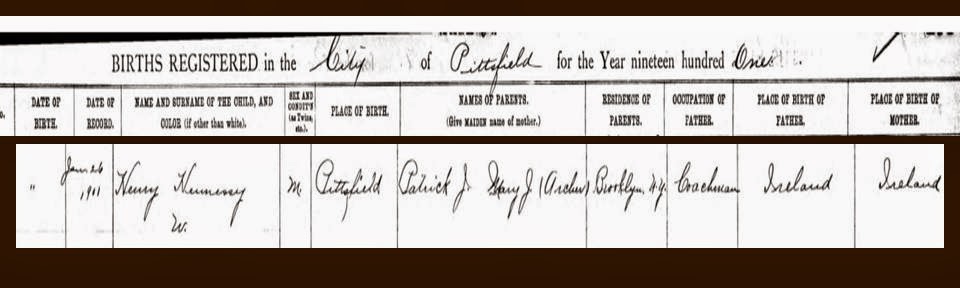

Henry had two older brothers, Joseph Hennessy, born in 1898 and Thomas Francis Hennessy (my grandfather) born in 1899.  Joseph and Thomas were born in NYC and Patrick's naturalization record indicates he was living in NYC in 1905, as well.  Patrick and Mary had a fourth son, John (Jack) Hennessy in 1906.  Mary died sometime between 1906 and 1910.   The 1910 census indicates that Patrick is a widow living with 3 of his sons in New Rochelle.  Patrick remarried in approximately 1914.  Henry Hennessy is included on the 1915 NY State census as living with his family in New Rochelle, consisting of his father, stepmother, Annie, his brothers Thomas and John and his infant half brother, James.

Groveland, NY - location of Craig Colony
By 1920, Henry was a patient at the Craig Colony for Epileptics in Groveland, NY.  His admission date is unknown, but must have been between 1915 and 1920.  The 1920 Census indicates that 7th grade was the highest grade Henry completed in school which would have been about the time of the 1915 when he was 13 years old.   There is no way to know when Henry first developed epileptic seizures, but it seems likely  he sought treatment for new or worsening symptoms around 1915 which eventually led to his placement at Craig Colony.    Henry was a patient at the Colony until at least 1940, which is the last census record available.


Craig Colony admitted it's first patient in 1896.  It was modeled after a colony in Germany and was originally designed to house 200 epileptic patients with the intent to specifically exclude the insane.   Overcrowding quickly became a major problem at the colony with over 1400 colonists in residence in 1911 and over 2700 at it's peak in 1939.   The colony had a working farm, craft shops, school and hospital with colonists employed in various trades, the intent being the colony would be self-supporting.  The doctors and administrators thought of the colony as the most humane treatment of epileptics at the time who they still considered to be mentally ill.  In one annual report, administrators wrote, “Not all epileptics are unusually irritable, or so much lacking in self-control, nor are all inclined to complain.”

Excerpts of a speech given by a physician in Chicago about 1907 regarding the problems of Epileptic patients and the best way to care for them.  

  • "If the adult [epileptic] be a man… he is very apt to be dangerous, as you know, and a source of danger to the rest of the family….  An epileptic may get a job between his attacks, but after his first attack, as a rule, his job is gone. No business man wants an epileptic around his premises.
  • “Those of you who have been in the home where the mother is epileptic know what a sad and pathetic sight it is.  The children are neglected.  The whole home is one of the most sad and depressing scenes into which an individual can go.”
  • Regarding epileptic child:  “Nobody wants him.  He is excluded from public schools and, very properly.  It is not fair to the rest of the children… that they should be exposed to seeing the contortions and writhings of an epileptic child….He is very apt to be the butt of scorn and ridicule of his playmates. ‘
  • “The best way and, the best remedy for this condition is … segregation of all epileptics into a community by themselves… epileptic colony or village.”
Even for those epileptics not institutionalized, marriage was difficult.  Laws prohibiting epileptics from marrying were passed in 18 states from 1895 to 1939.  The law forbidding marriage among epileptics in the United Kingdom was only repealed in 1970.  Principles of eugenics flourished leading to laws requiring sterilization of epileptics as well.   


Craig Colony accomplished the same goal as sterilization without surgery.  A medical director wrote in his report, "One great value of segregating epileptics in an institution like Craig Colony is that it cuts off, to a certain extent, an epileptic progeny, for the disease is handed down from parent to child in 16 percent of all cases.  

The Colony closed in 1968.  It is unknown if Henry Hennessy died while a patient at Craig or if he was discharged or transferred to another institution.  Many 'colonists' lost connection with their families after being placed in the Colony.