Monday, January 19, 2015

Grandma Winnie's Ancestry - Winifred (Cooney) Cox (1868-1956)

WINIFRED J. COONEY COX (1868-1956) 

Kilkishen Castle, Co. Clare
Winifred Josephine Cooney (my great grandmother) was born on April 11, 1868 in Galway, Ireland and was baptized in Kilkishen, Clare, Ireland.  Winifred was the first child born to Thomas Cooney (1847- ) and Mary Ryan Cooney (1841-abt. 1895).  
She had 4 sisters and three brothers:  Anne  (1869), John (1870), Bridget (1871), Pat (1873), Daniel (1877), Mary (1879), Margaret, 'Maggie' (1882), and Thomas (1886).  Most of her siblings were born in Kilkishen or Ballinabrone, Co. Clare which is where the family lived while Thomas worked as a farmer.  


    Winifred Cooney's marriage record 
    provides the names of her parents as 
    Thomas & Mary Ryan
  • Winifred emigrated to America about 1891,according to family, on the same ship as her future husband, John Cox. She was just 23 years old at the time.  John and Winnie married in 1899 in Massachusetts, settling first in Manhattan, then moving to New Rochelle, NY.  
  • Winifred's sister, Maggie Cooney followed her to America in 1899 and lived with John & Winnie until her marriage to Michael Sullivan after 1905. 

  • To learn more about Winifred's life in America see prior blog entry:  http://hennessycox.blogspot.com/2014/03/john-cox-ii-and-winifred-j-cooney-cox.html


Thomas & Mary Cooney 

Thomas Cooney & Mary Ryan wed in Limerick Ireland on May 26, 1867.  The city of Limerick is on the southern border of Clare Co. and Limberick Co. According to Census records, Thomas was a widower by 1900.  Records show the family living in East Clare and then Killuran in 1900 and 1910.  

Thomas was born in 1847, the son of Patrick Cooney possibly in Scariff, Clare Co.  His mother's name is unknown.  No further information is known about Thomas' family or parents.


Mary (Ryan) Cooney (1841- bef. 1900) 


Mary Ryan was
baptized on July 11,1841 in Ballinakill, Galway Co., Ireland.  Her parents were John Ryan and Mary (Salman) Ryan.  Her sponsors (godparents) were John Keegan and Ellen Salman.


Ballinakill Harbor


Galway County is north of Clare Co. on the West coast of Ireland. 
I have not been able to find any town named Ballinakill that exists today. There are several civil parishes with similar names and there is Ballinakill Harbor located near the city of Letterfrak.  


Three former civil parishes name Ballynakill in Galway Co.:
Ballynakill (Ballynahinch) (Galway)
Ballynakill (Killian) (Galway)
Ballynakill (Leitrim) (Galway)


However, Mary's baptism from the Roman Catholic Church Record, states,  

"Registry book of the baptisms for the United parishes of Ballinakill, Ballyroan, Abyleix & Knockgordegur."  This may be referring to a Catholic parish, not a civil parish.  

At this point, I can not confirm the exact location of Mary's baptism, except that it was in Galway Co., Ireland.  


I have not been able to locate any further information on Mary Ryan's parents or family. Irish census records for the 1800's are very sparse, making it difficult to find ancestors.  You can learn more about this in the prior post: 
http://hennessycox.blogspot.com/2014/09/snagging-slippery-irish-ancestors.html

I attempted to trace Winifred's sister, Maggie Cooney who was born to Thomas & Mary (Ryan) Cooney in Ireland in 1882 and emigrated to the US in about 1899.  I hoped if I found Maggie Cooney's family, I would be able to learn more information about their parents and ancestors.  

Maggie Cooney is listed on the federal census of 1900 and NYS census of 1905 as living with Winifred and John Cox.


The next census record, I located for the Cox family (1915) indicates Maggie is no longer residing with sister and brother in law. According to family, Maggie married Michael Sullivan and resided in or near the Fordham neighborhood of Bronx, NY.  Several Michael & Mary Sullivan can be found on census records residing in that area, but I have not been able to identify which if any of these pertain to Winifred Cooney's sister. 


Monday, September 8, 2014

Snagging slippery Irish Ancestors

Chances are you have sensed my frustration with those pesky Irish relatives who have so little imagination when choosing names and then arbitrarily change birthdates, if they bother to record births at all, thwarting any attempt to pin them down to a family tree.  Well, I'm going to share some of the bizarre circumstances that explain why locating our Irish ancestors is particularly difficult.

Sure I have discovered quite a bit of family history and unearthed some amazing documents, but there have been many bumps along the way, not just with those gaelic folks either. The basic approach to genealogy is to work backwards in time, but it ends up being more like a jigsaw puzzle than a straight path. The discovery of each new detail has the potential to lead you to your pot of ancestral gold, or down a long, arduous dead end or even to the realization that last few tree branches you painstakenly developed are blarney because you have once again latched onto someone else's relative! Not that I've done that -  well, at least I haven't crashed anyone's family dinner, yet.   

I am simultaneously impressed with the amount of information available on the internet and annoyed with those silly microfilms which can only be viewed in person. Many of the records held by the Catholic Church in Ireland- which it turns out are quite important- are on microfilm. These records represent brick walls, at least for now, so I can't help wondering why the genealogy elves haven't gotten them online yet.  I mean what do those elves do all day anyway?   Ofcourse if anyone happens to be in Dublin or Salt Lake City, feel free to swing on by and peruse those records.  I have citations and Roll numbers blah, blah, blah.  Yeah, I know, the last thing you want to do is spend your vacation stuck in a records room!

So why are those Church records so important?  Unfortunately, the vast majority of Ireland's Census records from the 19th century were either destroyed by fire or bureaucratic incompetence. Yup, on the bright side, this means me and the elves are completely off the hook!  
There are zero Irish Census records from 1860 to 1900.  They were destroyed intentionally by the government who apparently did not think they were necessary. 
Ok, but we still have the first half of the century, right?  Nah, that's pretty much gone too.  Back in 1922, a fire in the Public Record Office of Ireland destroyed most of the census records from the years 1821 to 1851, as well as many other documents and records.  That only leaves 1801 and 1811 intact.
Over 80 years of records wiped out, forget the bumps, that's a massive crater!  And it just happens to be the era when so many Irish came to America and thus, would have been a key link to their ancestry.

Currently,  I am trying to trace the Irish ancestry of my great grandmother, Winifred, who immigrated about 1890.   I do know the names of her parents, Thomas & Mary Cooney and I found the record of their 1867 marriage in Limerick. That record tells me Mary was born in 1841 and her father was John Ryan. Great, now all I have to do is find John Ryan, father of Mary, who lived in Ireland in 1841.  How hard could that be?  
   
Lets just say I am dreaming about Census forms!  Those vanishing records would have so much info -dates & places of birth, relationships, residences, occupations, maybe even parents place of birth- and, by process of elimination, I would have a good chance of finding the right family. Sometimes you get lucky and find a married couple actually living with or next to their in-laws on the census. But no such luck for me as the first available census is 30 years before Mary was born.  If John Ryan was alive, he would most likely be a wee lad and the census would not contain any details to identify him as Mary's father.

I am not giving up, though, and so I turn next to birth, baptism, marriage and death records, which each contain limited information, but combined could lead to the missing pieces of our puzzle.  Now, I swear there must a gaggle of leprechauns ROFL, because Ireland didn't officially record any of that rubbish until the year 1864, when the Irish civil registration of births, marriage and deaths began.
  
Prior to this, records were only kept by individual churches, but parish records did not follow a uniform practice regarding what information was captured, how the records were stored or maintained, thus there are holes and problems with the limited records that do exist.   

So the Catholic Church should have records of the Ryan family right? Well, maybe.  Although Ireland is predominantly catholic, there was discrimination against the Catholics that led to a law, in effect from 1703 to 1829, prohibiting Catholic churches from keeping any registers which means what records they do have didn't begin until 1830 or later.   Also, records of some Catholics may be found in the Church of Ireland for a number of reasons including the requirement that any marriage between a Catholic and Protestant be held in the Church of Ireland. 


Just to keep things interesting, for those sparse records that turn up, deciphering locations within Ireland is challenging.  Ireland has enough layers of ever changing jurisdictional divisions to make your head spin. And, of course, if those lads liked a name, they used it for multiple locations.

An address is typically written as Townland, Barony, County, but may contain the parish in addition or instead of one of the other areas. County Kilkenny, for example, is  800 sq. miles, smaller than the state of Rhode Island, yet, in 1802 it had 9 Baronies and 800 townlands. Today there are 12 Baronies, 137 parishes and some 1600 Townlands.

After all of this, I was about to throw in the towel, when I found the baptism of Mary Ryan in 1841.  All the pieces fit so she could be Winifred (Cooney) Cox's mother - my great great grandmother.  Now these records have been referenced and indexed by people smarter than me, but every once I think the elves get involved and run amok with the details so I like to double check. This record indicates it was in Ballinakill Co. Galway, but the first page of the record book states, "Registry book of the baptisms for the United parishes of Ballinakill, Ballyroan, Abyleix & Knockgordegur..."  I think. As you probably guessed, there are or were multiple parishes named Ballynakill in Ireland in multiple counties- Galway, Clare, Kilkenny, Laois... so I guess there's more work to do.  

Now, if I hadn't found this record, I probably would have gone off to do something trivial like make dinner, but those sneaky elves sent this baptism my way just to keep me hooked.  

Stay tuned for more information about Winifred Cooney Cox in the next blog post. 


Locations within Ireland

Ireland is divided into four provinces -the original kingdoms that predate the 12th century Norman invasion- which are culturally and historically significant, but have no governmental authority. Our ancestors are mostly from the provinces of Munster and Connaught which is in the Western part of the country and what is today, The Republic of Ireland. 
The principal governing layer in Ireland is the 32 Counties.  In most cases these are written as Co. Clare or Kilkenny Co., but not always and since there are cities and other locales with the same names as the counties it can be difficult to discern which is referenced.  
The counties were divided into baronies then into civil parishes and finally townlands. Baronies no longer have much purpose, but are still used for land registration and addresses.  Some baronies cross county lines.  Civil Parishes are not the sames as church parishes although in some cases they were aligned with the church of Ireland but not necessarily Catholic Church.  The 19th century saw countless changes, consolidation and restructuring of baronies and townlands throughout Ireland.  There are also Poor union law districts which are used for things such as probate records. 


Friday, August 29, 2014

Thomas Hennessy on the S.S. Republic

It's been a while since I posted on the blog.  Sorry, but I don't have much in the way of new information.  I did find out why it's been so hard to trace the Irish family roots. I'll explain more in my next post - stay tuned.

I also found the document below that shows Thomas Hennessy (1899-1954) working as a deck boy on the S.S. Republic the summer of 1925, which I thought was pretty cool.

At first, I wasn't sure it was the same Thomas Hennessy, but on the right it lists name and address of his next of Kin, in his case - "Fa -Patrick J.  Premium Pt. New Rochelle, NY."   His age on the ship is listed as 26 which would have been correct and he is identified as being 5' 8" tall with fair complexion, brown hair and brown eyes (although his draft card lists his eye color as blue).  His monthly rate (of pay) was $35. The ship arrived in New York on Sept. 7, 1925.

According to a memoriam published in a Fordham a newspaper, he received his undergraduate degree in 1922 and his law degree in 1925.   Thus this would have been the summer after he graduated.


Thomas F. Hennessy Draft Registration Card (1918)


see more about Thomas Hennessy and family at: 
 http://hennessycox.blogspot.com/p/blog-page_4947.html
http://hennessycox.blogspot.com/2014/03/thomas-f-hennessy-and-margaret-f-cox.html


Tuesday, July 15, 2014

Westchester County Newspaper articles regarding Thomas and Patrick Hennessy and Family

 Click on the image to see it larger.   
Images can also be viewed under Documents- Newspaper articles on the right hand side of blog.


Aug. 11, 1921-  County Veterans win College Scholarships - Thomas F. Hennessy at 101 Huguenot St. New Rochelle
Thursday Sept. 17, 1935  -  Democratic Party Delegates Named
Wednesday Octobe 4, 1939- Elected 2nd Vice Chairman of Westchester Democratic Committee
August 1951-  Desperately need 5 or 6 rooms


August 26, 1905- The Coachman of Premium Point will hold 7th annual picnic.  Officers include:  Patrick Hennessy as Sargeants-at-arms.

December 30, 1905-  Obituary for Mary Hennessy who passed away on Dec. 22, 1905 of Meningitis.  Funeral was held on Christmas Day at Church of Blessed Sacrament.  She leaves husband and four children.

June 1914-  The Wedding of Patrick Hennessy and Annie Hussey at St. Patrick's Church in Larchmont.  Spending Honeymoon in Atlantic City.

Sept. 1923 - Patrick Hennessy, chauffeur in New Rochelle, called for Jury duty in Murder Trial but excused due to an aversion to capital punishment.

Mary Hennessy Obituary - December 22, 1905


Mary Hennessy, wife of Patrick Hennessy, coachman for John G. Agar, died at her home on Premium Point last Friday afternoon, death being due to meningitis. She was born in Ireland and at the time of her death was in the 33rd year of her life. She had resided here a little over a year. Funeral services where held on Christmas Day from the Church of the Blessed Sacrament. The remains were interred at the Holy Sepulchre Cemetery.. She leaves a husband and four children

Blessed Sacrament Church
15 Shea Pl. New Rochelle
Founded 1848
Holy Sepulchre Cemetery
95 Kings Hwy  New Rochelle

Monday, June 23, 2014

Mary (Archer) Hennessy- Wife of Patrick Hennessy - Mother of Joseph, Thomas, Henry & John


Mary (Archer) Hennessy (abt. 1869- abt 1907) is my great grandmother.  She married Patrick Joseph Hennessy (1874- ) sometime before 1898.  While I have not been able to confirm the year of their marriage nor the year of Mary's birth or death, I have confirmed that she was Patrick's wife and the mother of his first four children.

Patrick and Mary lived first in Brooklyn, NY and then in New Rochelle, NY.  Patrick worked as a Coachman or Chauffeur.  They had four sons:  Joseph Hennessy (1898 - ), Thomas Hennessy (1899-1954), Henry Hennessy (1901 - ) and John (Jack) Hennessy (1906-  ).  Mary died sometime between the birth of John in 1906 and 1910 when Patrick Hennessy is listed as a Widow on Census records.
Premium Point, New Rochelle -  
Northern shore of Long Island Sound 

I have located only one census record in which Mary Hennessy appears - the 1905 NY census that has her residing in  Premium Point, New Rochelle, NY with her husband Patrick and three sons at the time - Joseph, Thomas and Henry.  Based on the location, names and ages of the children, approximate ages of Mary and Patrick, as well as Patrick's occupation and country of origin, I am certain this is the correct Census record for Mary and Patrick.  However, not all the details are accurate.   Patrick's age is given as 29, but he would have been 31 (1874); plus the census has him immigrating to the US in 1890 when, in fact, it was January 11, 1894 according to his naturalization record.  Mary is listed as born in Ireland and coming to America in 1890, same as Patrick. Mary's age on the census is difficult to read, but appears to be either 31 (1874) or 36 (1868).  I believe 36 would have been her correct age.
  • The 1905 NYS census relied on information provided verbally by any family member or a neighbor. It was not uncommon to assume a wife's information was the same as her husbands. Age information of adults was often an approximation or even a guess.
Its certainly possible Mary and Patrick were married in Ireland and came to the United States together or happened to arrive the same year, but I have not found any record to prove or disprove this.  All of their children were born in the US, with the oldest born 4 years after Patrick arrived.


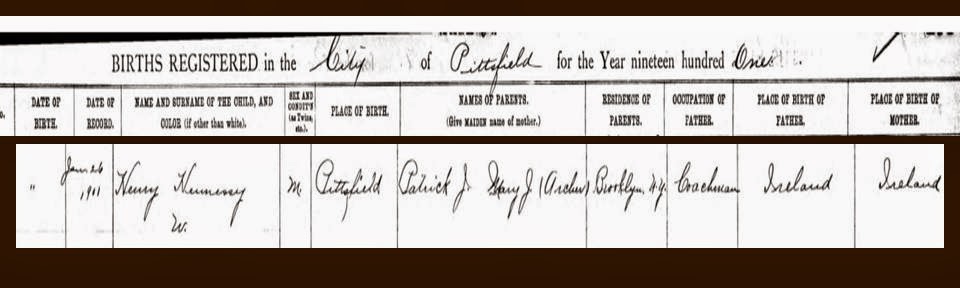
The only other definitive record I found belonging to Mary, is the birth record of Henry in Pittsfield, MA in 1902.  Although Henry was born in Massachusetts, the record lists Patrick and Mary's address as Brooklyn, NY at the time which appears consistent with other records as both Joseph and Thomas were born in Brooklyn.   Henry's birth record also indicates Patrick's occupation as a Coachman, identifies Mary's maiden name as Archer and her middle initial as possibly J and states both Patrick and Mary were born in Ireland.

I have been unable to find any other information that I believe conclusively identifies Mary. Presumably, Mary is buried somewhere in Westchester county as is Patrick Hennessy, but I have not been able to find either of their graves.  Patrick remarried and remained in the Premium point neighborhood of New Rochelle with his second family at least until 1940 as documented by the Census of that year.  Keep in mind, that all of the names I am searching- Mary, Archer & Hennessy- are incredibly common, particularly for immigrants coming from Ireland or England during that time period.  There are hundreds of records of both Mary Archer and Mary Hennessy as well as Patrick Hennessy.  I have concluded that the vast majority of these records are not related to our family.

 All of this brings me to a tale of the one and only lead I have into the roots of Mary (Archer) Hennessy....

SUSPECTED CONNECTION

On October 1, 1875,  Sarah (Andrew) Galloway Archer (1831-1912) arrived in New York Port with three of her children,  Hugh, Matilda and Mary.   They had come aboard a ship called, "The State of Virginia," sailing from Glasgow, Scotland.   The New York port was just a stop along the way to their destination of Philadelphia where they joined the rest of their family, including  Richard Archer Sr. (1830- aft 1895) and Richard Archer Jr.  The two Richards had come to America in 1872.

 15 years earlier, Sarah Andrew Galloway and Richard Archer were married on September 5, 1860 in Ballymena, Ireland according to Ireland's Civil Marriage records.   Sarah was the daughter of James Andrew and the widow of David Galloway.  She had three children from her first marriage - Jane, Hugh and Matilda- when she married Richard.  The oldest, Jane Galloway (1855-1897) married in 1872 and remained in Ireland when the rest of the family emigrated to America in 1875.

Sarah had two more known children with Richard.  Her son, Richard Jr. was born in 1862 and Mary was born in November of 1867.  The family moved to Dundee, Scotland sometime prior to Mary's birth.  They are documented in Dundee on the 1871 Scottish census record which gives ages as follows:  Sarah Archer 35,  Jane Galloway 16, Hugh Galloway 13, Matilda Galloway 10, Richard Archer 9, Mary Archer 3. These ages make more sense since Hugh and Matilda were from Sarah's first marriage and are older than Richard. Once in the USA, Hugh primarily assumed the Archer surname, while Matilda may have continued to use Galloway until her marriage.
  • Unfortunately, I can't share this census as the Scottish government has released information but not the original census images.  The record is detailed, though, as it gives full names and ages, as reported by the family, of all persons in the home on that day as well as their place of birth.

Bridge to Dundee Scotland
 According to the Scottish census and civil birth records, Mary was born in the city of Dundee,  Forfarshire/Angus County, Scotland on Nov. 5, 1867.  Both her parents and siblings were born in Ireland so it is likely that Mary considered her nationality to be Irish.  Even, the ship passenger list above indicates her place of birth as Ireland along with the rest of her family.  


The Archer family settled in Philadelphia, residing at 535 Charter St. in 1880.  Richard Sr. was working as a carpetweaver as were his sons Hugh (22) and Richard Jr. (18).  Matilda was 20 years old and worked in a woolen mill while Mary was 11 and attended school. 

2676 Martha St. Philadelphia PA- built in 1875
According to Philadelphia city directory for Richard Archer Sr., the family resided at 535 Charter St. Philadelphia until 1890 when they moved to 2136 Charter St.  In 1894 and 1895 Richard and Sarah were residing at 2676 Martha St. Philadelphia.   That is the last record for Richard Archer Sr.  He died between 1895 and 1900 when Sarah is documented as being a widow on the Census.  

In 1900 Sarah was residing with her son, Richard Jr., his wife Maggie and his 4 yr. old son Richard,
at 2676 E. Lehigh Ln Philadelphia.  Sarah was 68 years old, widowed and the mother of 9 children, 4 of which were still living.  Her oldest daughter Jane passed away in 1897.  The other children we know about- Hugh, Matilda, Richard and Mary - were all living in 1900.  There must have been another 4 children that died prematurely.  

In 1910 Sarah was living at 3243 Joyce St. Philadelphia in the family home of her daughter and son-in-law, Matilda and Charles Seiler.  At this time,census records state only 3 of Sarah's children were still living which is consistent with her daughter Mary (Archer) Hennessy having passed away prior to 1910.    Regarding Sarah's other childrenMatilda and Richard both died after the 1920 census, but Hugh's date of death is unknown.  

Sarah Archer passed away on Sept. 27, 1912 in Philadelphia at the age of 81.  She had survived the death of two husbands and six of her nine children, resided in three countries and on two continents, traveled across the atlantic and as a mother, grandmother and  great grandmother had grown a new branch of her family in America.   Her Death certificate confirms her age as 81, that she was widow, born in Ireland, the daughter of James Andrew and buried on Sept. 30, 1912 in Philadelphia, PA although the name of cemetery is unknown.  Richard Archer's place of burial is also unknown.

Richard probably had a brother, George Archer (1834-1905) who also emigrated to the US and settled in Philadelphia with his wife Mary (McKnight) Archer.  George is buried with his wife at  Greenmount 
Cemetery, 4301 North Front Street Philadelphia PA.   It is possible that Richard & Sarah Archer are buried there as well. 


Friday, May 2, 2014

Life of Henry Hennessy, brother of Thomas F. Hennessy, at Craig Colony

Henry Hennessy spent a significant part, if not all, of his adult life at Craig Colony for Epileptics in upstate New York.  Craig Colony was modeled after an idyllic vision of  a safe, productive environment where epileptics could live their lives in peace with proper medical care.  The reality was not so idyllic and the premise that epileptics needed to be segregated because they were either contagious, dangerous to society, or 'not right in the head,' could not have been more erroneous.

Henry Hennessy is my great uncle, my grandfather's brother.  Few, if any, will be searching for him on ancestry websites as he has no direct descendants.  He wasn't allowed to marry or fraternize with females at Craig Colony.   Despite attempts to simulate a home environment for colonists, as they were called, Craig Colony was an institution specifically designed to keep male and female patients from interacting, with the sexes entirely separated by a rocky ravine.  Epilepsy was understood to be a brain disorder by the late 19th century, but there was no effective seizure medication and epileptics faced severe discrimination making it almost impossible to live a normal life.  Prior to the establishment of Craig Colony, many were committed to insane asylums.

Henry J. Hennessy was born on January 21, 1901 in Pittsfield Massachusetts, the third son of Patrick Joseph Hennessy and Mary J. (Archer) Hennessy.    Patrick and Mary were living in Brooklyn in 1901 as documented on Henry's birth record, their reason for being in Massachusetts at the time is unknown.  The birth record includes Patrick and Mary's full names and Patrick's occupation  as a coachmen, as well as Henry's date of birth.


Henry had two older brothers, Joseph Hennessy, born in 1898 and Thomas Francis Hennessy (my grandfather) born in 1899.  Joseph and Thomas were born in NYC and Patrick's naturalization record indicates he was living in NYC in 1905, as well.  Patrick and Mary had a fourth son, John (Jack) Hennessy in 1906.  Mary died sometime between 1906 and 1910.   The 1910 census indicates that Patrick is a widow living with 3 of his sons in New Rochelle.  Patrick remarried in approximately 1914.  Henry Hennessy is included on the 1915 NY State census as living with his family in New Rochelle, consisting of his father, stepmother, Annie, his brothers Thomas and John and his infant half brother, James.

Groveland, NY - location of Craig Colony
By 1920, Henry was a patient at the Craig Colony for Epileptics in Groveland, NY.  His admission date is unknown, but must have been between 1915 and 1920.  The 1920 Census indicates that 7th grade was the highest grade Henry completed in school which would have been about the time of the 1915 when he was 13 years old.   There is no way to know when Henry first developed epileptic seizures, but it seems likely  he sought treatment for new or worsening symptoms around 1915 which eventually led to his placement at Craig Colony.    Henry was a patient at the Colony until at least 1940, which is the last census record available.


Craig Colony admitted it's first patient in 1896.  It was modeled after a colony in Germany and was originally designed to house 200 epileptic patients with the intent to specifically exclude the insane.   Overcrowding quickly became a major problem at the colony with over 1400 colonists in residence in 1911 and over 2700 at it's peak in 1939.   The colony had a working farm, craft shops, school and hospital with colonists employed in various trades, the intent being the colony would be self-supporting.  The doctors and administrators thought of the colony as the most humane treatment of epileptics at the time who they still considered to be mentally ill.  In one annual report, administrators wrote, Not all epileptics are unusually irritable, or so much lacking in self-control, nor are all inclined to complain.

Excerpts of a speech given by a physician in Chicago about 1907 regarding the problems of Epileptic patients and the best way to care for them.  

  • "If the adult [epileptic] be a man… he is very apt to be dangerous, as you know, and a source of danger to the rest of the family….  An epileptic may get a job between his attacks, but after his first attack, as a rule, his job is gone. No business man wants an epileptic around his premises.
  • “Those of you who have been in the home where the mother is epileptic know what a sad and pathetic sight it is.  The children are neglected.  The whole home is one of the most sad and depressing scenes into which an individual can go.”
  • Regarding epileptic child:  “Nobody wants him.  He is excluded from public schools and, very properly.  It is not fair to the rest of the children… that they should be exposed to seeing the contortions and writhings of an epileptic child….He is very apt to be the butt of scorn and ridicule of his playmates. ‘
  • “The best way and, the best remedy for this condition is … segregation of all epileptics into a community by themselves… epileptic colony or village.”
Even for those epileptics not institutionalized, marriage was difficult.  Laws prohibiting epileptics from marrying were passed in 18 states from 1895 to 1939.  The law forbidding marriage among epileptics in the United Kingdom was only repealed in 1970.  Principles of eugenics flourished leading to laws requiring sterilization of epileptics as well.   


Craig Colony accomplished the same goal as sterilization without surgery.  A medical director wrote in his report, "One great value of segregating epileptics in an institution like Craig Colony is that it cuts off, to a certain extent, an epileptic progeny, for the disease is handed down from parent to child in 16 percent of all cases.  

The Colony closed in 1968.  It is unknown if Henry Hennessy died while a patient at Craig or if he was discharged or transferred to another institution.  Many 'colonists' lost connection with their families after being placed in the Colony.  


Thursday, April 17, 2014

What about all those Irish Surnames....

As I began researching our family roots, I was pretty confident I would find my maternal ancestors were predominately Irish with just a sprinkling of English for good measure, as Mom would have said.  I admit I was curious about the alleged connection to "English royalty," my grandmother had claimed and my mother scoffed at. Just in case you're waiting to find our place in line for the thrown, you may want to keep that day job.  I have yet to find any evidence of a royal connection.

What I have found are amazing clues into the lives of working class families, enchanting English villages and a tiny glimpse of what those brave souls emigrating to America may have endured.  My great grandfather, John Cox II, made the trip alone when he was 21 years old, while many others brought their entire family in tow.  The journey, in the mid 1800's, would have taken about 5 weeks aboard a sailing ship, although, by the late 1800's steam ships could make the trip in just 2 weeks for those who could afford them.  It wasn't an easy trip, trapped aboard a cramped ship with limited food and water, conditions perfect for spreading disease.  My ancestors were of modest means and most probably had to scrimp and save to pay the fare, leaving behind everything they knew, for the chance to start a new life in a new world.  As their lives have enfolded before me, I have come to know them as living, breathing people, making the issue of their heritage almost irrelevant to me. 

 Ah, but this is a genealogy blog, afterall, and so I will get back on point.  I have written several posts about the English heritage of the Cox and Bolton families, which can be traced back generations in the East Midland region of England.  The Irish side has proven much more difficult to trace beyond my great grandparents.  There is, however,  information that can be gleaned from the Surnames themselves that I want to share.  I should point out that the distinction between Irish and English, and even Scottish, heritage is often blurry as the history of these countries is so intertwined.  A good example is the recent discovery I made concerning my great grandmother, Mary J. Archer, who is Irish, but may have been born in Dundee Scotland, although both her parents and her siblings were born in Ireland. It appears the family lived in Scotland for a short time before coming to America- check back for more about Mary Archer's life in an upcoming blog entry.  


Ironically, the Archer name (Thomas Hennessy's mother) can actually be traced to nobility almost 1000 years ago and even to the Lord Chancellor of Ireland a mere 700 years back.i


About Surnames

Most Irish names are patronymic - based on the given name of one's father or male ancestor.  The classic Irish O at the beginning of names translates to "son or descendant of."   Typically surnames would come from nicknames given to the chief of a sept or clan.  Also  medeival english did not have spelling rules and names were written as they sounded to the scribe.  It was not uncommon for one person to use different spellings during their lifetime.


Hennessy Surname

hennessyHennessy - originally O'Hennessy- comes from the Gaelic word aonghus, meaning choice or chosen one. The name predates the Norman invasion.  At the time, the leading Hennessy clan, was based near Kilbegan in Offaly county . Upon the arrival of the Normans in Ireland in the 12th century, the Hennessys are said to have scattered to Limerick, Tipperary, and Cork.
  
Aonghas, anglicised ‘Angus’, one of the pre-Christian Celtic gods

Today 42% of Hennessy families reside in Ireland, 28% in the US and 16% in England

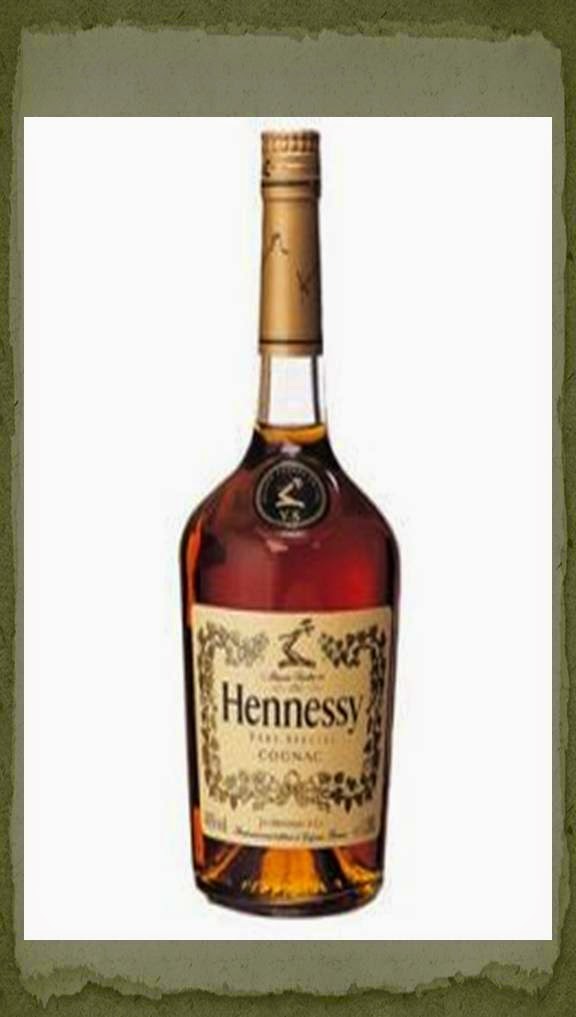
The Hennessy name may be best known for it's Cognac.  Hennessy brandy was first distilled by Richard Hennessy (1720-1800), born in Ballymacmoy House near Mallow in north County Cork. Richard joined the french army in about 1740 to fight the English, becoming an officer in Dillon's Irish Regiment. He was stationed in the Charente region of France discovering the beautiful town of Cognac on the banks of the Charente River.  It was there that he founded Maison Hennessy, the distillery, in 1765. Today, Jas Hennessy & Co sells about 50 million bottles a year and Richard Hennessy's descendents are still involved in the operations.  The Hennessy house at Killavullen near Mallow, overlooking the River Blackwater, can still be seen today and the Hennessy distillery in Cognac is open to visitors..
http://www.hennessy.com/us/maison/visit

Archer Surname

My great grandmother: Mary (Archer) Hennessy

The Archer name came to England at the time of the Norman Conquest in 1066, and is derived from the french name, Le Archier. The word literally means an archer which replaced the English word 'Bowman' in the 14th century.   Variations of spelling include Le Archer, Archier, Archar, Arsher, Arshire, Archere, Archire, and many others.   here is actually a great deal written about the Archer family history in England. the Archer name is said to be included in the Battle Abbey Rolls - which was William the Conquerers list of Companions.  They were a noble family in the middle ages, involved in politics throughout the England & Ireland.

A branch of Archers settled in Ireland in the1200s and became one of the Tribes of Kilkenny.  Le Archer, appears in the records of Kilkenny (city), in 1307 and from 1345 to 1652 the Archer name is found 64 times in the city's lists of  Magistrates, Sovereigns, Mayors, Sheriffs, Coroners.

John L'Archers was appointed to the office of  Lord Chancellor of Ireland in about 1342.  He is believed to have been born in England and had a distinguished political career in Ireland, serving as Ireland's Chancellor from about 1342 until he succumbed to the plague in 1349.

I haven't yet determined where in Ireland Mary Archer's family originated, but the Archer name was prominent throughout England and Ireland.

Notable Archers of Kilkenny Ireland:
John Archer, sovereign of the town of Kilkenny - 1439 
Walter Archer, sovereign of Kilkenny - 1544 
Walter Archer Sr., Sovereign of Kilkenny in 1590
Thomas Archer, elected mayor, but removed - 1611 
Patrick Archer, mayor - 1611-2 
Walter Archer, mayor - 1621 & 1625 & 1627 
Henry Archer, mayor - 1628-9 
Thomas Archer, mayor - 1641 
Walter Archer, mayor - 1643-4 

Notable Archers throughout United Kingdom
Robert Le Archer -tutor to King Henry I (1100-1135); received a grant of 7 manors;  possibly same Robert L'Archier, mentioned in "Pipe Rolls of Warwickshire", dated 1166
Richard and Nicholas Archer - on 1214 census of noblemen known as Rotundi Oblitus et Finibus
Roger Archer  mayor of Waterford in 1361
Sir Simon Archer (1581– 1662) sat in the House of Commons in 1640
John Archer(1598-1682) knighed in 1624, sherriff of Warwickshire in 1628.
David Archer, Constable of Gowran in 1608. 
Baron Archer of Umberslade-Cornwall County - A title held first by Thomas Archer and then his son, Andrew, as members of parliament in the years 1747 to1778.  


COONEY SURNAME
My great grandmother: Winifred (Cooney) Cox

The Cooney name comes from the Gaelic Ó Cuana -pre-10th century. meaning "elegant" or the "son of elegant one". The Cooney sept originated in the Ulster County Tyrone in Northern Ireland and migrated west to North Connaught, a province in Western Ireland, by the 11th century.   Some branches moved to Tipperary and Offaly.  In 1248 the most distinguished member of the sept, Diarmid O Cuana, "the great priest of Elphin," died.

Winnifred Cooney was born in Galway in Northern Connaught, where most of the Cooney families reside today.  Spelling variations include:  Conan, Coonan, O' Cooney, Cooney, Counihan, and Coonihan

Friday, April 4, 2014

Family of Sophia (Bolton) Cox (1846-1934)


Sophia Bolton was born in 1846 in Market Harborough, England, the daughter of James Bolton  (1812-1886 ) and Elizabeth (Charlton) Bolton (1812-1891) my 3rd great grandparents.

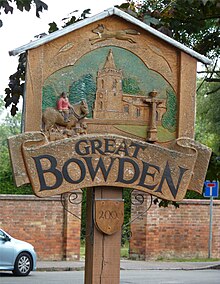
James and Elizabeth were married on March 13, 1834 in Great Bowden, Leceistershire.  They raised their family and lived most of their adult lives on Middle Green in Market Harborough, Great Bowden, while James worked as an agricultural Laborer (ag lab) and a Shepherd.    Their 10 children, born from 1836 to 1857, were named, in order:  James, Emma, Thomas, Eliza, Sophia, Alice, Alfred, Stephen, Mary and Fredrick.

The first English Census that captured the personal information of families was in 1841.  Earlier censuses in England were limited to head counts for taxation purposes.  The 1841 census listed everyone in the household, but did not indicate their relationship to the head of house.  That census included a teenager, Anne Bolton, residing with the Bolton family.  She was, most likely, a relative of James living with them temporarily, perhaps as a mother's helper or servant which was common at the time.  She was too old to be their daughter and there is no record of James and Elizabeth having a daughter named Anne.

Ten years later, in 1851, the Boltons remained at Middle Green, but Sophia was no longer residing with her parents.  At 15 years old, she was living and working as a house maid for a Widow, Mary Rowlatt in Great Bowden.  Sophia probably continued to work as a maid until her marriage to John Cox in 1869.  James Bolton passed away in 1886, while his wife, Elizabeth died 5 years later in 1891.

I have not been able to identify Elizabeth (Charlton) Bolton's parents.

James Bolton was the son of George Bolton (1781-1856) and Mary Martin (1786-1865).  George and Mary were wed on Nov. 2, 1802 and had 8 children.  James was 4th oldest, born in 1812.  The other children, in order of their ages, were: Hannah, Elizabeth, Amy,  James, Edward, Anne, Thomas, Mary and Sarah.  

The 1841 Census shows George and Mary Bolton residing in Bowden Magna, Leicestershire with five of their children Elizabeth (age 30), Edward (25), Anne, (20), Thomas(19) and Mary(15) while George and his son, Thomas, worked as agricultural Laborers.  Edward listed his occupation as a Gardener.  At the time, 1841, James had been married for seven years and was living with his family in Market Harborough.  His other siblings that were not included as living with George and Mary, were probably either married or working elsewhere.  The English Census rules required documentation only of those family members present in the home on the specific day of the census.  It was conducted on a Sunday night so it was presumed most family members would be home, but some were visiting elsewhere, in hospitals or even working as maids or servants which was very common at the time, particularly for teenage girls.


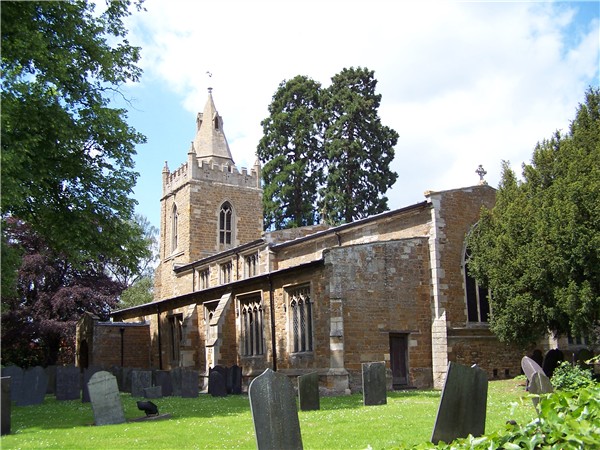
St. Peter & St. Paul Church, Great Bowden - built before 1220

George Bolton(1781-1856) was baptized on July 2, 1781, the son of William Bolton (abt.1738-1827) and Mary (Bailey) Bolton (1751-1822)  at St. Peter & St. Paul Parish Church (Anglican Church of England) in Great Bowden.  He had at least one brother, William Bolton (1776-1857) also baptized at this church.  Based on the age of his parents, it is likely there were other, older siblings.  


Note: George's brother William  had 10 children.  A number of George's and William's children have the same name. Fortunately baptism records indicate the names of their parents for all of William's children and most of George's children.  It appears that after William's first wife, Kezia, died prematurely he remarried and had another family.  William  also has a son named James but he was born in 1830, 28 years after Sophia's father.


Possible, but unproven family connections


At this point the ancestory becomes murky.  The father of William Bolton (1738-1827) may be Richard Bolton (b. 1715), but I have been unable to confirm William's date of birth, place of birth or parents. There was no requirement in England in prior to 1837, to register the birth of a child and, while baptisms did have be recorded, it was done by individual church's without any uniform rules regarding what information was captured and how the records were maintained.  In the absence of any records, I don't know where the assumption originated that Richard Bolton was the father of William Bolton (1738-1827), but I am unable to confirm it.

Richard Bolton was born Nov 3, 1715 and baptized on Nov. 13, 1715 at St. John The Baptist in Croydon, Surrey the son of John and Susan Bolton.   The name of Richard Bolton's spouse as well as,the location and date of his death are unknown.  Richard Bolton is referred to, in other family trees and references, as a 'squire' although I have not found any record or basis for this.  A squire in the middle ages was the apprentice to a Knight, but in the 1700s the term squire was used to denote a "Lord of the Manor", who may have owned much of the land in a village or area, or a gentleman with a coat of arms- perhaps the descendant of a Knight- or even a village leader or Justice of the Peace. 


It may be possible to continue to trace Richard Bolton's family back further, However, I am uncertain he is William's father, and thus our ancestor.  There are a few troubling inconsistencies discussed below.  

  • Richard was born in Surrey, an affluent village south of London, approximately 125 miles from where William, his supposed son, was born.  Richard could have moved from Surrey to Great Bowden, although that seems unlikely given that he appears to have been a land owner or related to land owners in Surrey.  Whereas, Great Bowden and the county of Leicestershire consisted mostly of working class families.   
    • One possibility is that Richard's family went into debt as a result of supporting King Charles during the English Civil War from 1642-1660, forcing the family to sell their land and relocate. Though, to date, I  have not found evidence that Richard Bolton ever lived in or near Great Bowden.
  • England naming patterns of the time made it common to name the first and 2nd born sons after their grandfathers and the 3rd son after his father, etc.   It was not strictly adhered to and, given the lack of baptism records, there are certainly children I have not identified.  Yet, I have not found any children, grandchildren or great grandchildren of William Bolton (1737-1827) named Richard Bolton, which seems highly unlikely if Richard was indeed William's father and George and William Jrs grandfather. 
Bolton Surname - comes from olde english - pre 7th century 'bothl' or 'botl'- meaning dwelling house/hall with the olde englsih 'tun' meaning enclosure or settlement.  In England the original Bolton families were established in the Lancashire area, but over the centuries covered all of the country and parts of Wales.  Greatest populations remain in Lancashire and Yorkshire.